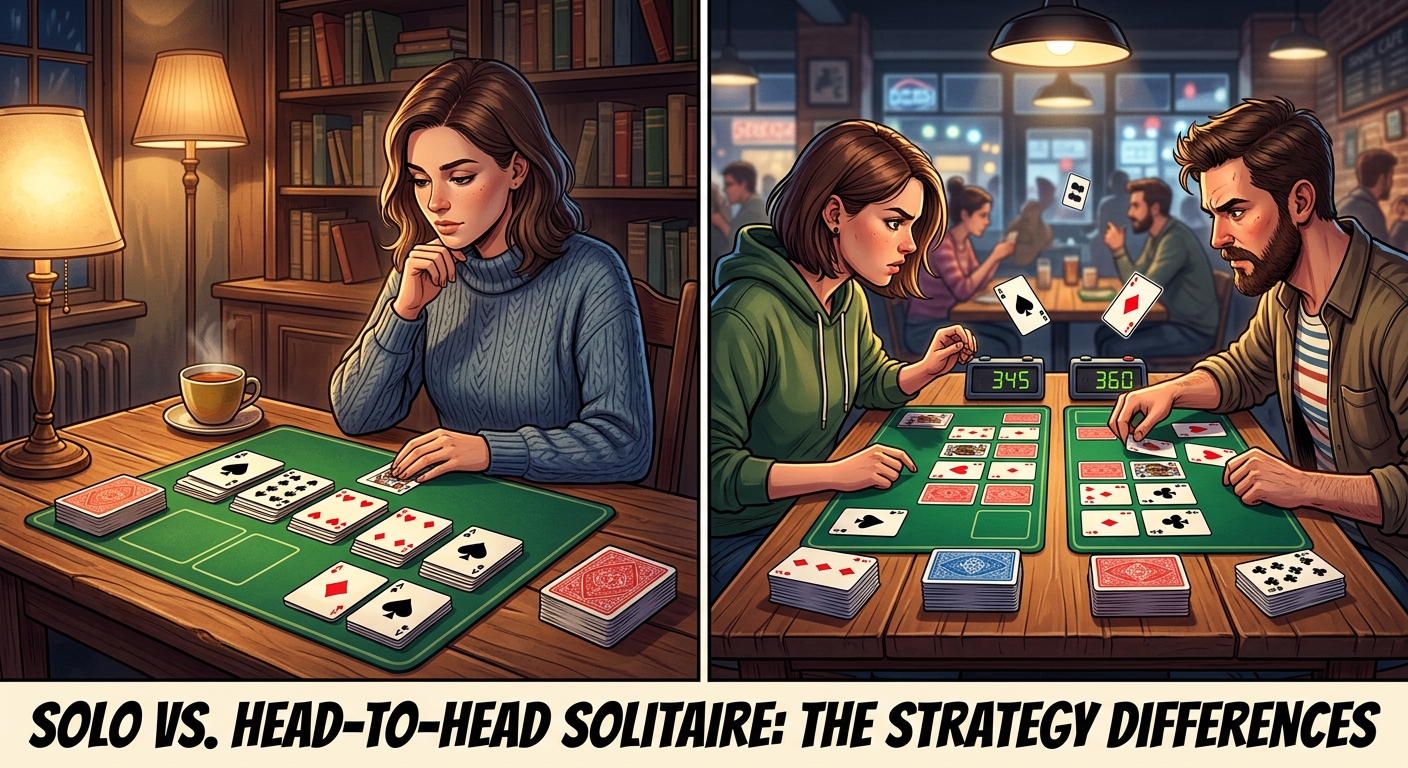
Solitaire has a reputation as the ultimate solo activity. You, a deck, and silence. But that reputation misses something. The skills you build in solo play say a great deal about how you would perform against a real opponent, and competing against live players reveals gaps in your game you would never spot playing alone.
Strategic Shift
Solo solitaire and head-to-head play might share the same deck, but they demand different minds. In solo play, patience and careful sequencing win the day. Against a real opponent, speed and willingness to sacrifice safe moves become just as valuable. The good news is that the two formats sharpen each other. Build your instincts alone, test them against others, and you will return to solo play with a measurably better game.
The Mindset That Solo Play Quietly Builds
Most players come to solitaire the same way. They start with Klondike, figure out the basics, and gradually develop a feel for the game. What they often do not realize is that they are building genuine strategic instincts in the process.
Card sequencing is the obvious skill. You learn to think several moves ahead, stacking cards in ways that open up new plays rather than closing off your options. But there is a subtler skill growing underneath that: risk tolerance calibration. You start to sense when it is worth flipping a card from the stockpile and when holding back gives you a better foundation.
The history of solitaire as a solo thinking exercise stretches back centuries. patience card games were originally designed as single-player puzzles, and that solitary nature shaped the strategic conventions players carry forward today.
These conventions are valuable. Patience under uncertainty, careful planning before committing, reading the board before acting. All of it transfers into competitive play. The question is whether it transfers cleanly into a format where someone else is also trying to win.
Sequencing and Probability in the Solo Format
When you play alone, probability is your only opponent. You are asking yourself what the next card might be, whether the buried card you need is likely to surface in time, and whether the move you are about to make will help or hurt three turns from now.
This kind of thinking rewards patience. There is no cost to pausing. Nobody is racing you. The deck does not punish you for thinking longer, and the board stays exactly as you left it while you weigh your options.
That freedom trains a specific kind of deliberate mind. You build the habit of calculating before acting. You get comfortable sitting with uncertainty rather than rushing through it. Over time, this becomes instinct. You stop second-guessing your read on a sequence and start trusting it.
This is genuinely useful. But it is also a habit shaped by conditions that change completely the moment a second player sits down.
How a Real Opponent Reshapes the Strategic Landscape
The fundamental shift in head-to-head solitaire is this: time becomes a resource. In solo play, time is free. In competitive play, every second you spend deliberating is a second your opponent might use to pull ahead.
This changes the relationship between caution and speed. A safe move in solo play might be a slow move in competitive play. A slightly suboptimal card sequence might still be the right call if it gets you a step ahead before your opponent finds a better line.
The psychological pressure is real, too. Watching someone else work through the same layout at pace puts a kind of invisible hand on your shoulder, nudging you to move faster than your instincts might prefer. Managing that pressure without letting it disrupt your read on the board is itself a skill that solo play simply cannot teach.
Good competitive players learn to separate the feeling of urgency from the actual need for urgency. Not every moment demands speed. But knowing which moments do, and acting on that judgment fast, is a form of strategic awareness that only develops through live competition.
Risk Tolerance and When to Sacrifice the Safe Play
In solo solitaire, conservative play usually rewards you. Taking the certain move over the risky one is often the right call because you are optimizing for completion, not for finishing ahead of anyone.
Competitive formats flip that logic in specific situations. These are the moments when accepting risk becomes the smarter strategy against a live opponent:
- When you are behind and the safe move keeps you behind, the risky play at least offers a chance to pull level.
- When you can see your opponent closing in on a win, speed matters more than perfect sequencing.
- When a speculative move opens a run of plays, the short-term gamble can generate enough momentum to offset the risk.
- When the board is relatively open and both players have similar positions, acting faster on a good-enough move beats waiting for a perfect one.
- When your opponent is visibly hesitating, pressing forward with an assertive line can compound their uncertainty.
The skill is not learning to be reckless. It is learning to recognize the specific moments when caution becomes a liability, and shifting your approach precisely at those points.
Speed Without Sloppiness: Calibrating Your Pace
One of the hardest adjustments competitive solitaire demands is playing faster without losing accuracy. This is not a minor tweak. It requires a different kind of board reading.
In solo play, you tend to read the whole board before committing to a move. In competitive play, you learn to read the most relevant part of the board first, act on that, and continue reading as you go. It is closer to the way a chess player calculates during time pressure: not fewer moves ahead, but a faster path to the most important calculation.
Practicing this transition is where the strategic theory of head-to-head play becomes genuinely practical. Playing Solitaire Multiplayer against live opponents online puts you directly into that pressure environment. You get immediate feedback on where your pace is costing you and where your instincts are actually sharp enough to trust at speed.
That feedback loop is hard to replicate any other way. Articles and guides can describe the adjustments. Only live play tests whether you have actually made them.
What the Competitive Format Reveals About Your Solo Habits
This is where it gets interesting. Most players who move from solo play into competitive formats discover something they did not expect: their solo habits have blind spots.
Common ones include over-relying on undo as a safety net, taking too long to process obvious moves, and defaulting to conservative sequencing even when the board is calling for something bolder. None of these habits are obvious problems in solo play. They become obvious problems the first time an opponent exploits the time you spent being careful.
The good news is that identifying these blind spots is genuinely useful. A player who has competed and lost because they were too slow has learned something that hours of solo play would never have taught them. They return to the solo format with a cleaner read on their own tendencies and a sharper eye for where those tendencies serve them and where they do not.
Comparing Strategic Priorities Across Both Formats
| Strategic Element | Solo Solitaire | Head-to-Head Play |
|---|---|---|
| Decision pace | Deliberate, no time pressure | Fast, with accuracy maintained |
| Risk tolerance | Conservative moves preferred | Risky plays viable at key moments |
| Planning horizon | Several moves ahead, unhurried | Near-term efficiency prioritized |
| Pressure source | The deck and probability alone | Opponent pace plus the deck |
| Undo reliance | Often available and used freely | Limited or unavailable entirely |
The Loop Between Competition and Solo Mastery
The most useful thing competitive solitaire does is make you a more self-aware solo player. After you have played enough head-to-head games, you start noticing your hesitation points in solo play. You see where you default to conservative lines out of habit rather than necessity. You catch yourself second-guessing reads that your competitive experience has already validated as reliable.
The patience that solo play builds does not disappear under competition. It gets refined. You stop applying patience where speed would serve you better, and you double down on patience where it genuinely pays off, because now you know the difference from experience rather than instinct alone.
Players who treat these two formats as completely separate are leaving improvement on the table. The sharper your head-to-head instincts, the more clearly you can see your solo game. The stronger your solo foundations, the more calmly you operate under competitive pressure.
Two Formats, One Sharper Player
Solo solitaire and head-to-head play are not competing versions of the same game. They are two sides of the same strategic development. One teaches you depth. The other tests it under real conditions.
Start with solo play. Build the sequencing habits and the patience that go with it. Then take those habits into live competition and find out where they hold up and where they need work. Bring that knowledge back to the solo table, and you will find that your planning is cleaner, your risk reads are sharper, and the quiet game you play alone is actually more skilled than it was before you ever faced an opponent.
The deck does not change. Your relationship with it does.